

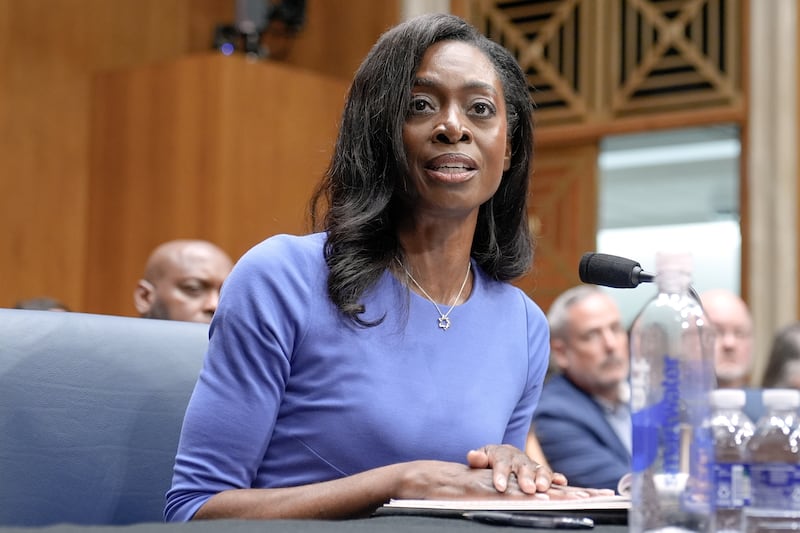

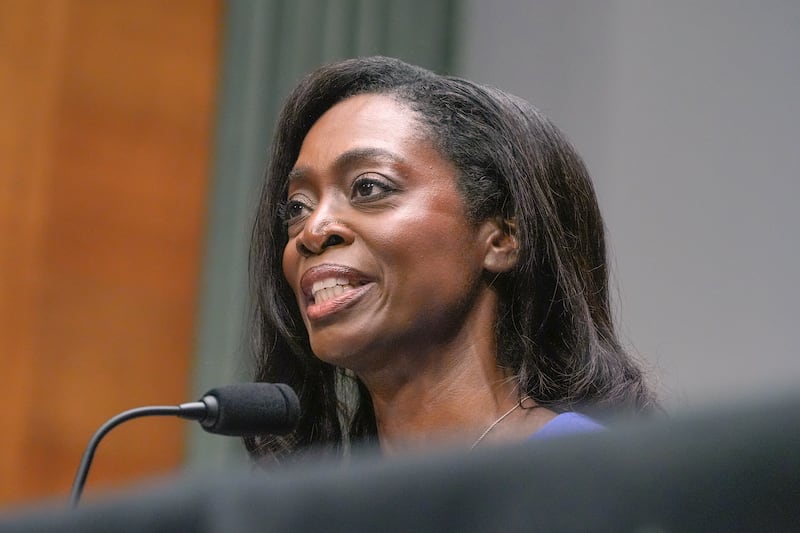
As the U.S. Senate debated whether to confirm Dr. Erica Schwartz to head the Centers for Disease Control and Prevention, the headlines largely concerned her position on childhood vaccinations and whether she would be a rubber stamp for Health and Human Services Secretary Robert F. Kennedy Jr.
But there was something else that was bothering abortion-rights supporters: Schwartz’s advocacy for more comprehensive reporting of abortions.
The issue came up during the confirmation hearing, when Arkansas Sen. Josh Hawley asked Schwartz if she would commit to “trying to get as much information — again, collect the data — on the number and circumstances of abortion, as is provided for in this system,” including from those states that don’t provide abortion information to the CDC under what is now a voluntary system.
Schwartz responded yes, saying, “Senator, you have my commitment. Abortion surveillance is a critical component to what the CDC is currently doing.” She added that she believes it’s important to find out if states are including abortion numbers under the category of “emergency services,” thus providing an incomplete accounting.
The exchange would have been unremarkable if Hawley and Schwartz had been discussing the collection of data on, say, asthma in children, or hypertension in older adults, both among data tracked by the National Center for Health Statistics. The center’s website currently features data on young people’s consumption of caffeine, the incidence of high blood pressure in pregnancy and the rate of inflammatory bowel disease in adults.
But the collection of data on abortion is politically charged and highly inflamed, even though it’s been a task of the CDC since 1969. It’s so inflamed, in fact, that many people don’t want to talk about it — the American College of Obstetricians and Gynecologists declined an interview “at this time” and the Centers for Disease Control and Prevention did not respond to multiple inquiries.
Part of the problem flows from the Supreme Court’s 2022 decision in Dobbs v. Jackson Women’s Health Organization, which overturned Roe v. Wade and gave states authority to make their own law about abortion. Since Dobbs, 13 states have banned abortion; others have restricted or expanded access.
Although none of these states in which abortion is banned prosecute women who obtain abortions, abortion-rights supporters see the CDC’s longstanding term for data collection — abortion surveillance — as newly sinister. They see Schwartz’s vow to expand the collection of that data as weaponization designed to support the anti-abortion movement.
“The push to expand abortion surveillance is part of anti-abortion extremists’ broader strategy to monitor, restrict, and ultimately criminalize abortion access,” the abortion-rights advocacy group Reproductive Freedom for All said in a statement opposing Schwartz’s selection to head the CDC.
But abortion opponents say it’s reasonable and necessary for the government to collect data on the elective termination of pregnancies, noting that abortion-rights supporters often describe it as “healthcare.” They cite other mandatory reporting, also called surveillance, such as that required for fetal deaths after 20 weeks of gestation.
“Americans deserve access to current and complete statistics to inform policy, measure abortion trends and analyze the impact of abortion on women. Everyone on both sides of this issue should agree on the need for better reporting,” said Karen Czarnecki, executive director of the Charlotte Lozier Institute, the research division of the nonprofit Susan B. Anthony Pro-Life America.
As the system now exists, however, the Guttmacher Institute, a nonprofit that supports abortion rights, has become one of the primary sources for abortion data in the U.S.
Will Schwartz, who was sworn in to her new post last week, change that?
How many abortions take place in the U.S.?

“The best available abortion statistics today show at least 1.1 million abortions a year in the U.S., even more than before Roe v. Wade was reversed,” said Czarnecki, at the Charlotte Lozier Institute.
Those numbers cannot be confirmed by the CDC, which has not issued new data during the second Trump administration.
Prior to 2022, and since 1969, the CDC had annually released data compiled from states (plus Washington, D.C., and New York City) that responded to its request for information on the number of abortions and characteristics of the women obtaining them. According to KFF, a nonprofit focused on health policy, “most states collect and report data on the demographic characteristics of patients, gestational weeks and type of abortion procedures.”
But there are notable holdouts, including states like New Hampshire, Maryland and California, which historically have not supplied data.
The Guttmacher Institute, once an arm of Planned Parenthood, offers a more robust look at the abortion landscape with information obtained from abortion providers in all 50 states. But Guttmacher, which did not respond to an interview request, acknowledges on its website that its own numbers are incomplete, since they do not include what they call “self-managed” abortions — which include “those using medications mailed from pharmacies outside the United States or sourced from community networks.”
“Evidence suggests self-managed abortions have increased since Dobbs,” the institute says.
There were, Guttmacher reports, an estimated 1,126,000 abortions in the U.S. in 2025, slightly more than the 1,124,000 reported in 2024.
This represents an increase of 21% from 2020.
Why is abortion data collected?
Stephanie Pell, a fellow at the Brookings Institution’s Center for Technology Innovation whose work includes research on privacy and reproductive health, said abortion-rights supporters are rightly concerned about expanded surveillance because it’s unclear how the administration plans to use the data.
“Perhaps under a different administration, this wouldn’t be as problematic, but I think the worry is, why does the government want this data, for what purpose, what level of granularity?” Pell said.
“Ideally we want to be able to share information that is protected and anonymized if we believe our government is going to use it for good public policy. That is just not a given today,” she added. “In a post-Dobbs world, it is concerning when the government is requesting more information without legitimate justification for the need for that information.”
But Dr. Christina Francis, CEO of the American Association of Pro-Life Obstetricians and Gynecologists, argues that there are broad benefits from the collection of data.
“Mandatory abortion reporting, as well as reporting of maternal mortality based on specific pregnancy outcomes, would strengthen public health data. It would also enable the public, policymakers, and medical professionals to better understand not only the impact of induced abortion on women’s health but also the true causes of maternal mortality so that we could better prevent these tragic deaths,” Francis said.
And notably, the struggle over abortion information predates the Trump administration.
California, for example, hasn’t collected data on abortions since 1997, according to the nonprofit Cal Matters, meaning it hasn’t reported to the CDC under both Republican and Democratic administrations, without explaining why.
In the wake of Dobbs, that lack of data was frustrating for abortion supporters, who said they needed to be able to prepare for people who might come from other states to obtain an abortion, Kristen Hwang reported for Cal Matters.
According to the CDC website: the abortion data is collected primarily for three reasons:
- To “evaluate programs aimed at promoting equitable access to patient-centered quality contraceptive services in the United States, to reduce unintended pregnancies.”
- To “assess changes in clinical practice patterns related to abortion over time, such as changes in method and gestational age at the time of abortion.”
- To “estimate the number of pregnancies in the United States, using the number of pregnancies ending in abortion, in conjunction with birth data and estimates of pregnancy loss.”
The Comstock Act and abortion drugs
Fueling the worry among abortion-rights supporters is the belief that the Trump administration may intend to start enforcing the Comstock Act, a law enacted in 1873 that prevented anyone from mailing “any article or thing designed or intended for the prevention of conception or procuring of abortion.”
Although Comstock has long been considered a “zombie law” that is not enforced even though it has not been repealed, the prevalence of medication abortions, which account for about two-thirds of abortions in the U.S, makes it of interest to abortion opponents, who see enforcement of the law as a means of reducing the number of abortions, if not ending abortion altogether.
In an article published in Yale Law Review last year, Reva Siegel and Mary Ziegler spoke of Comstock “revivalists” who have “embraced an edited version of the obscenity statute as the abortion ban they cannot persuade the nation to enact.” Joanne Rosen, who teaches at Johns Hopkins’ Bloomberg School of Public Health, has said that a literal interpretation of the law “could essentially shut down abortion nationwide.”
And in addition to their opposition to Schwartz, abortion-rights supporters were alarmed by Trump’s selection of Todd Blanche as attorney general. Blanche said in a call with faith leaders leaked to the press that he was concerned about people getting around state laws that prohibit abortion by obtaining abortions — and abortion drugs — from other states.
Per Politico, Blanche said during the call, “If states have said, ‘We are going to protect the unborn and we’re going to protect every life from the moment of conception,’ we’re putting practices and policies in place so that other states and other organizations can’t attack that. They can’t do things like they’re doing with mailing in mail-order drugs.”
He did not, however, speak to Comstock specifically, Politico said.
And however many abortion opponents may populate the Trump administration, the president has shown there is a limit to how far he will go to appease them. Although he once called himself “the most pro-life president in American history” and his Supreme Court picks resulted in the Dobbs decision, Trump has fallen out of favor with many in the anti-abortion movement during his second term because of what they see as his failure to do more to restrict abortion.
Writing for the journal First Things last month, Jonathon Van Maren said that Trump had “betrayed” the pro-life movement, suggesting that his position on abortion shifts with perceived political advantage. Trump’s views on abortion could be influenced by those of his wife, who famously wrote in her 2024 memoir, “A woman’s fundamental right of individual liberty, to her own life, grants her the authority to terminate her pregnancy if she wishes,” but with a caveat: “Timing matters.”
Is abortion a crime?
While many abortion opponents consider the act of ending a human life in utero murder, even states with the strongest abortion laws shield women who obtain abortions from prosecution. In Texas, for example, doctors and other healthcare providers can be criminally charged with providing an abortion, and people who “aid or abet” an abortion can face civil penalties, but there are no provisions for punishing the mother.
Still, with abortion opponents like Hawley talking about people who “commit” abortion, abortion-rights supporters say that could change, and they see robust collection of data as a tool that could be used to prosecute women.
While noting that her role in the debate is as a researcher, Pell, at the Brookings Institution, said, “I very much share the concerns raised by abortion-rights groups and advocates in objecting to the sharing of more data without very specific statements about what it is going to be used for what protections are being provided for the data.”
To Czarnecki, with the Charlotte Lozier Institute, however, “The lack of quality, comprehensive abortion data in the U.S. is a national scandal,” and there is no risk of legal jeopardy for women.
“Importantly, the data are anonymized; there is no personally identifying information,” she said.